Hi there! I am Yunfei Ge, a master's student in Computer Engineering at Northwestern University, where I am fortunate to be advised by Prof. Manling Li at the MLL Lab and mentored by Qineng Wang on spatial reasoning and multimodal agents. I am also grateful to work under the guidance of Prof. Michael Yip at UCSD ARCLab and mentored by Soofiyan Atar on embodied AI and robot learning. During my undergraduate study, I feel thankful to be advised by Prof. Yao(Mark) Mu at Shanghai Jiao Tong University ScaleLab.
Looking for a Fall / Spring 2027 PhD opportunity
🔥 News
Our paper MindTopo was accepted to five NeurIPS 2026 workshops: NEmo (Oral Presentation), VLM4RWD (Oral Presentation), BabyVLM (Oral Presentation)! See you in Sydney!
Our paper GameLogicBench has been released as a preprint.
Our paper MindTopo has been released as a preprint.
Our paper MMG2Skill was accepted to Findings of EMNLP 2026.
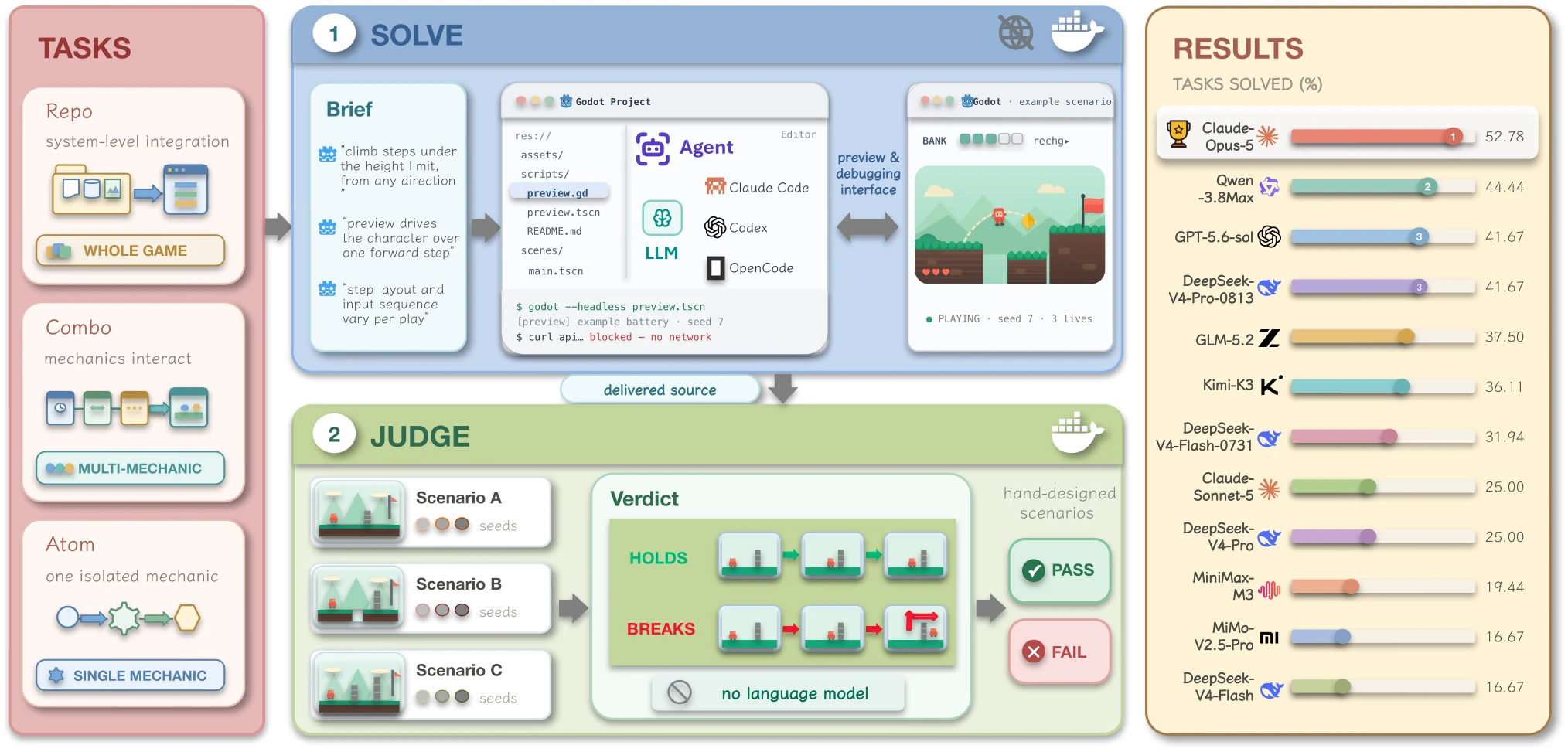
Coding agents can now modify and test code across large software projects. Game development is one such domain, where agents must implement gameplay rules. A game can end in a valid state even after violating its rules during the run. Current game-development benchmarks replay fixed examples, score videos, or ask another model to judge the result. However, no existing benchmark checks game rules throughout execution across varied evaluator-selected scenarios while ensuring exactly reproducible verdicts. We introduce GameLogicBench, a benchmark of 72 gameplay-logic tasks in Godot projects. An automated evaluator checks each game's rules at every simulation tick. Across 403 hand-designed scenarios, seeded parameter variations produce 1,451 test cases. To ensure that the evaluator measures behavior rather than implementation choice, it must accept different correct implementations for each task while rejecting mutants, implementations with one required capability removed. The tasks span isolated mechanics, multi-system interactions, and repository-scale features. Across 20 combinations of language models and scaffolds, the best observed run solves 52.78% of tasks. Under Claude Code, all twelve models solve fewer tasks as task scope expands from isolated mechanics, through interacting systems, to repository-scale features. Agents inspect code more often and make more tool calls on repository-scale tasks than on isolated-mechanic tasks. Most unsuccessful submissions are runnable, but implement some required game behavior incorrectly. We compared versions of our benchmark evaluator built with and without validation using mutants. Without this validation, some incorrect agent submissions passed. A separate analysis finds agents copying code from the original public repositories when network access is open. Reliable evaluation thus depends both on what the tests reject and on what external code agents can access.
arXiv 2027
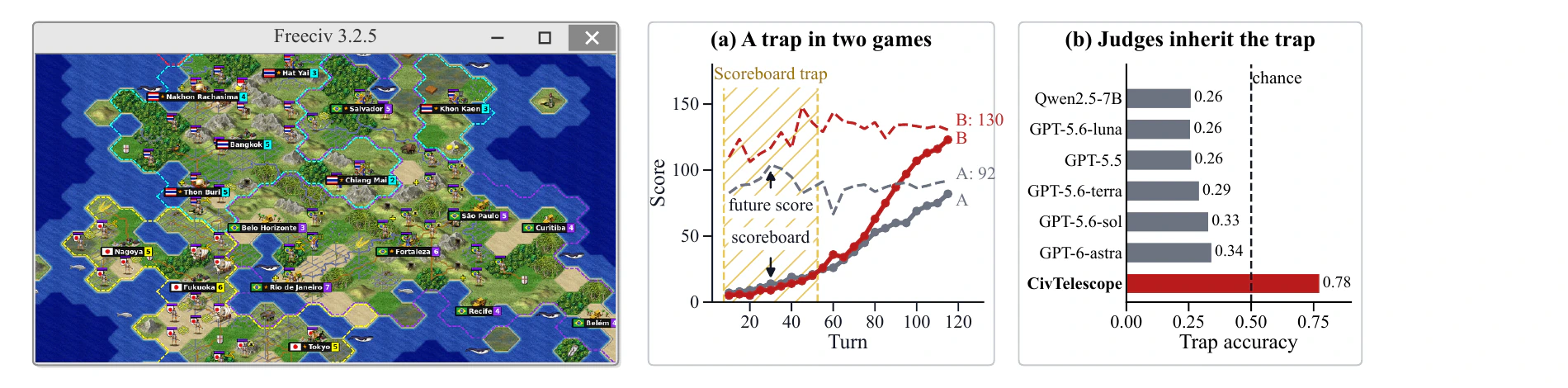
Replay-Grounded Signals for Long-Horizon Civilization Agents
Yanchen Liu, Xinyu Che, Brihi Joshi, Renzo Fukuda, Junhua Liu, Ruifeng Li, Yunfei Ge, Hang Yan, Xiang Ren · ICLR 2027 under review
arXiv 2026
MindTopo: Can Foundation Models Reason in Topological Space?
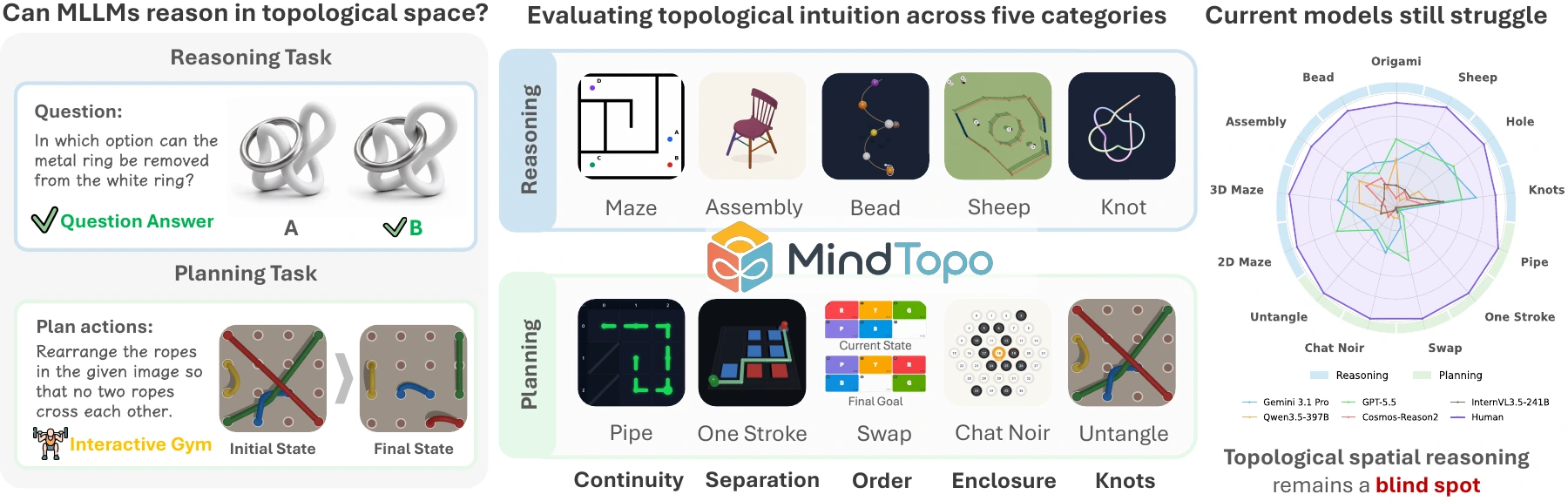
Spatial reasoning depends not only on metric properties such as distance, angle, and shape, but also on topological relations that remain invariant under continuous deformation. Cognitive science identifies these relations as foundational to spatial understanding, yet foundation-model evaluations largely focus on metric or viewpoint-dependent relations. We introduce MindTopo, a benchmark of topological intuition across five properties grounded in cognitive science and formal topology: continuity, separation, order, enclosure, and knots. MindTopo evaluates each property at two cognitive levels. Reasoning asks a model to identify topological relations or infer how they change. Planning instantiates a foundation model as a closed-loop agent whose policy selects environment actions. MindTopo contains 11,035 instances across 13 procedurally generated task types with controllable difficulty. We benchmark 13 MLLMs and study agent configurations augmented with image and video generation, including three video generative models in planning settings. Every MLLM performs better on reasoning than on planning, and the best-performing model remains far below observed human performance. On Qwen3-VL-2B-Instruct, supervised fine-tuning and reinforcement learning improve reasoning more than planning. Generated observations retain local cues and reach plausible endpoints, but audited rollouts do not reliably follow environment dynamics or preserve topology across transitions.
EMNLP 2026
MMG2Skill: Can Agents Distill In-the-Wild Guides into Self-Evolving Skills?
Xinyu Che*, Junqi Xiong*, Yunfei Ge*, Xinping Lei*, Shihao Li*, Hang Yan*, Han Li, Yuanxing Zhang, Zhiqi Bai, Jinhua Hao, Ming Sun, Han Li, Jiaheng Liu · EMNLP 2026
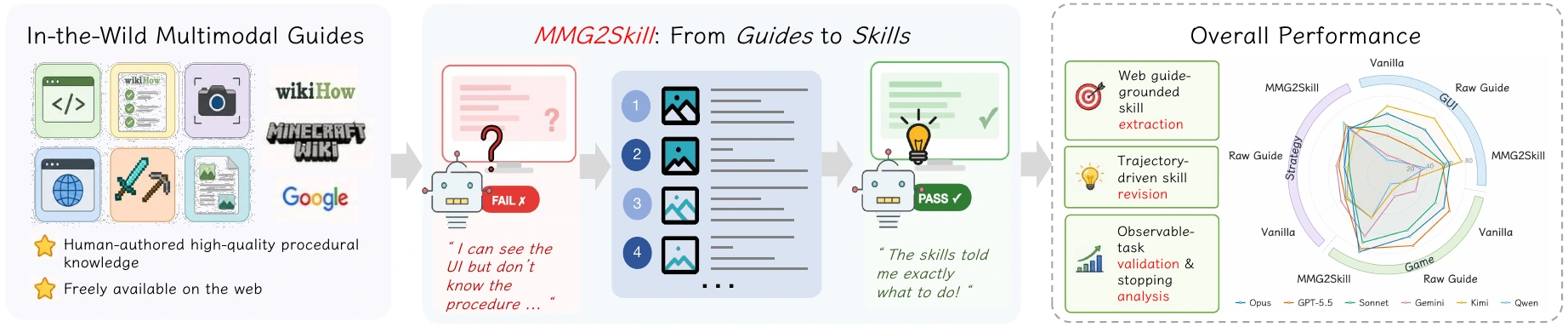
Abundant procedural knowledge on the Web holds great potential for helping agents solve long-horizon tasks. However, such knowledge is often multimodal, heterogeneous, noisy, and implicitly assumes human executors, making it difficult to use directly as the skills required by agents. To bridge the gap between human-oriented guides and agent-executable skills, we formalize this problem as guide-to-skill learning: converting in-the-wild guides into executable skills and continuously improving them from trajectories observable to the agent. To evaluate the capability of existing agents on this task, we introduce MMG2Skill-Bench, the first benchmark designed for this problem. We further propose MMG2Skill, a closed-loop framework that compiles guides into editable skills, conditions a fixed vision-language model (VLM) agent on these skills during execution, and revises the skills from trajectory-level root-cause feedback without using benchmark scores. Across GUI control, open-ended gameplay, and strategic card play with six VLM backbones, MMG2Skill consistently outperforms vanilla baseline agents in every model-domain setting, achieving macro-average gains of +12.8 to +25.3 percentage points across backbones. Ablation studies show that directly prompting agents with raw guides can degrade performance, while both structured skill construction and trajectory-driven revision are necessary for the observed improvements. On success-inferable tasks, analyzer-based early stopping further prevents late-stage performance regressions and saves 25%-53% of attempts when the success signal is properly calibrated.
Experience
Oct 2026 - Present
Embodied AI Research Intern · BAAI, Beijing
Jun 2026 - Sep 2026
Research Intern · ARC Lab, University of California, San Diego
Sep 2025 - Present
Research Intern · MLL Lab, Northwestern University
Nov 2025 - Dec 2025
AI Engineer Intern · Wegwiser
Apr 2025 - Sep 2025
Research Intern · Scale Lab, Shanghai Jiao Tong University
Apr 2025 - Aug 2025
AI Engineer Intern · Duo LuoLuo
Nov 2023 - May 2024
Software Engineer Intern · SAIC Maxus
Sep 2021 - Apr 2023
Vision & Mechanics Group Member · RoboMaster Robotics Competition, Shanghai University
Dec 2018 - Dec 2020
Team Leader · VEX Robotics Competition, Shanghai Minhang High School